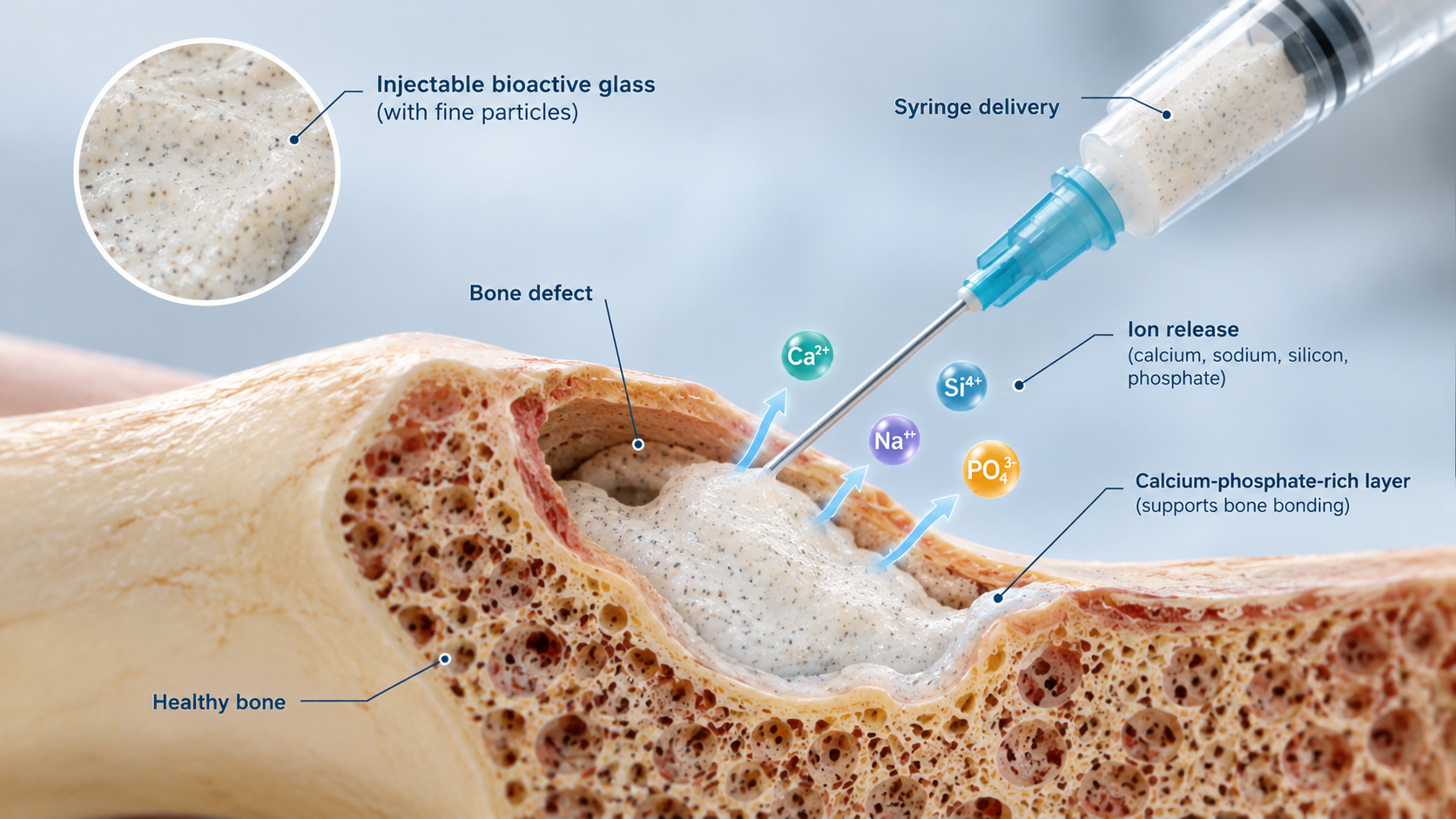


Bone repair has traditionally involved surgical procedures and grafting techniques to restore damaged or missing bone. However, advances in bio materials are opening up new approaches to bone regeneration.
One area receiving increasing research attention is inject-able bio-active glass.
Unlike a conventional solid graft, injectable bioactive glass can be formulated as a flowable or moldable material that may be delivered through a syringe or a minimally invasive surgical approach. This makes it an interesting platform for treating localized or irregular bone defects where placing a conventional graft can be technically challenging.
Among bio-active glass compositions, 45S5 bio-active glass has been extensively investigated because of its bio-active and osteoconductive properties and its potential role in bone-defect treatment and regenerative medicine. [1]
Injectable bio-active glass is a bio-active glass-based material formulated into a flowable or moldable paste.
The idea is relatively simple: instead of using only a solid or particulate graft that needs to be placed directly into a bone defect, the material can be formulated in a way that allows it to be delivered into a targeted area.
This can be particularly useful when the bone defect is irregular, localized or difficult to access.
Bioactive glass has already been investigated in several forms, including:
These different forms have been studied for regenerative applications. [1,2]
An inject-able bone graft substitute may contain bio-active glass particles combined with a suitable carrier or liquid phase. However, creating an effective inject-able formulation involves more than simply mixing glass particles with a liquid.
The formulation needs to be carefully engineered so that it provides suitable:
Several formulation factors can influence the behaviour of inject-able bio-active glass.
These include:
In other words, the performance of an inject-able material depends not only on the bio-active glass itself, but also on how that glass is formulated.
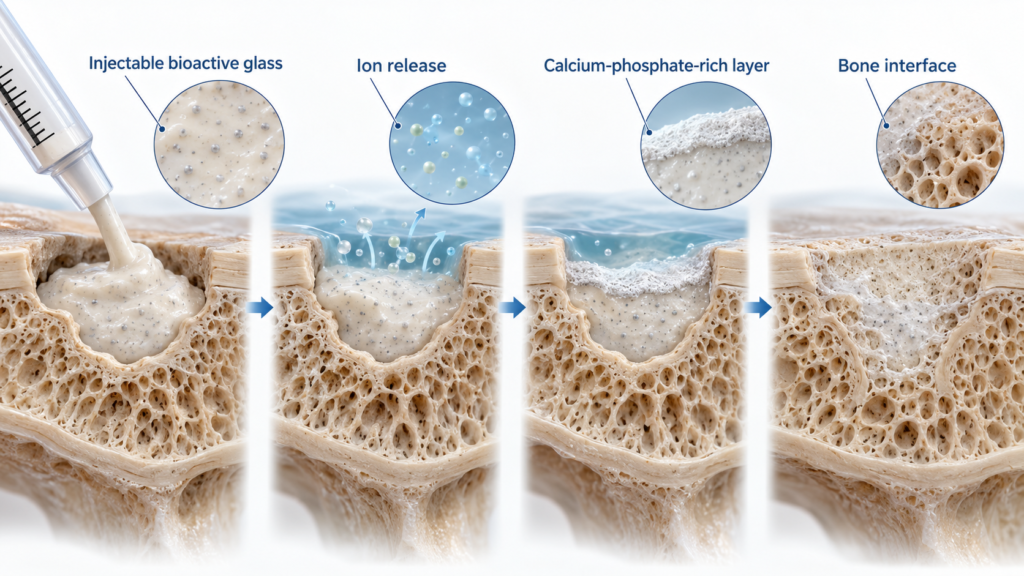
Traditional bone repair procedures may require direct access to the area being treated. Minimally invasive approaches aim to address bone defects while reducing the extent of surgical exposure.
This is one reason why inject-able bio materials are being investigated.
An inject-able material can potentially be delivered through a relatively small access point and then maintained within the targeted bone defect. Its flowable nature may also allow it to adapt to localized or irregular spaces where conventional graft placement may be difficult. [1,2]
This makes minimally invasive bone repair an important area of bio materials research.
However, the potential benefits of inject-able delivery depend on the final formulation and the specific clinical application.
To understand how bio-active glass for bone regeneration is being investigated, it helps to look at what happens when the material comes into contact with physiological fluids.
Bioactive glasses are generally made from glass-forming and modifying oxides.
One of the most widely studied compositions is 45S5 bio-active glass.
The classical 45S5 composition contains approximately:
by weight. [1]
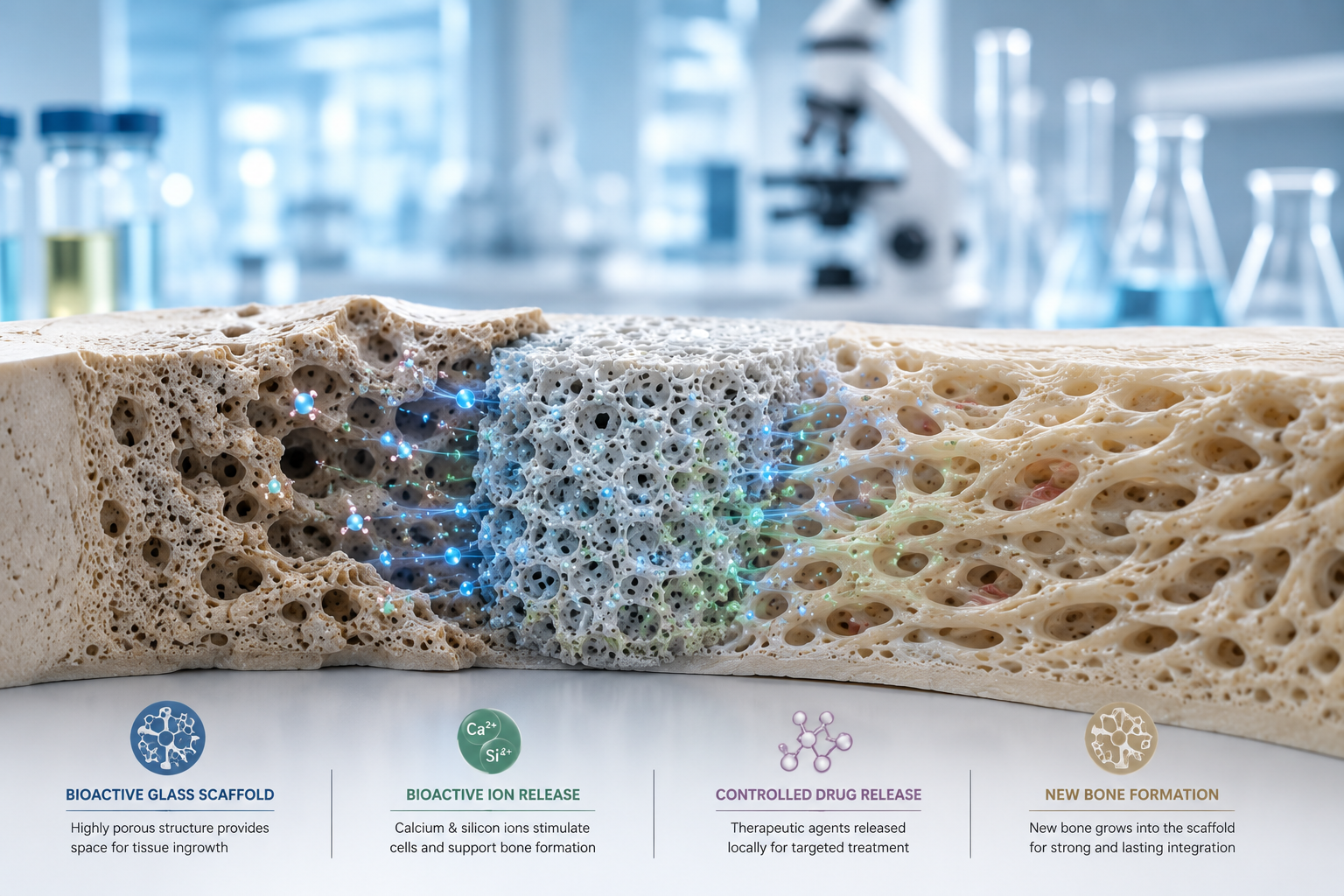
When bio-active glass comes into contact with physiological fluids, reactions begin to occur at the surface of the glass.
These reactions can lead to the formation of a calcium-phosphate-rich layer that resembles the mineral phase associated with bone.
There are three important aspects to this process: ion release, interaction with bone cells and surface-layer formation.
One of the key characteristics of bio-active glass is its interaction with physiological fluids.
When this happens, ions can be released from the glass network. Depending on the composition, these may include:
These dissolution products can influence the biological environment surrounding the material. [3]
The type and amount of ions released depend on the composition of the bio-active glass and other material characteristics.
The ions released from bio-active glass can influence cellular behaviour.
Research has investigated how these ions may provide biological signals associated with osteogenic responses, meaning responses related to bone-forming activity.
However, this response is not the same for every bio-active glass formulation.
It can depend on factors such as:
Therefore, the biological response needs to be considered in relation to the specific formulation being studied. [3]
When bio-active glass interacts with physiological fluids, a calcium-phosphate-rich or hydroxycarbonate-apatite-like surface layer can form.
This surface can provide an interface that is favorable for interaction with bone tissue. [1,3]
For an inject-able formulation, however, the final structure is influenced by more than the glass itself.
Factors such as the carrier, particle packing, porosity, setting behaviour and degradation characteristics can also affect the resulting material.
Research into bio-active glass has extended across both orthopaedic and dental bone regeneration.
Injectable formulations are being investigated particularly for situations where controlled delivery into a localized or irregular bone defect may be advantageous.
Bone defects can vary considerably in their size, shape and location.
Injectable bio-active glass may be investigated for filling contained or irregular bone defects, particularly where conventional graft placement can be challenging.
Research involving 45S5 bio-active glass has evaluated bone-defect applications using different experimental models and material configurations. [1]
These include:
Injectable bio materials are also being investigated in situations where controlled delivery into anatomically challenging bone defects may offer advantages. [2]
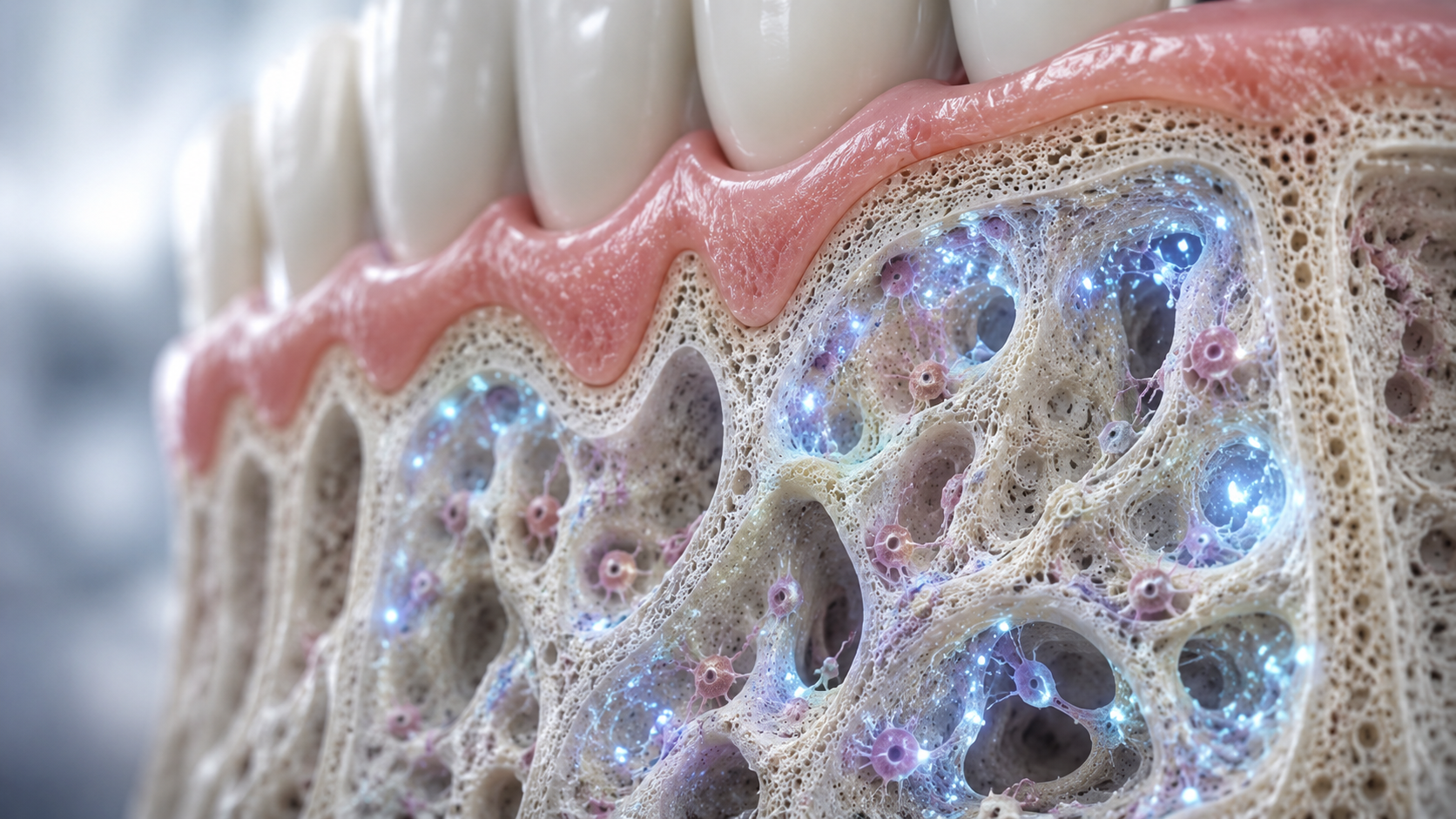
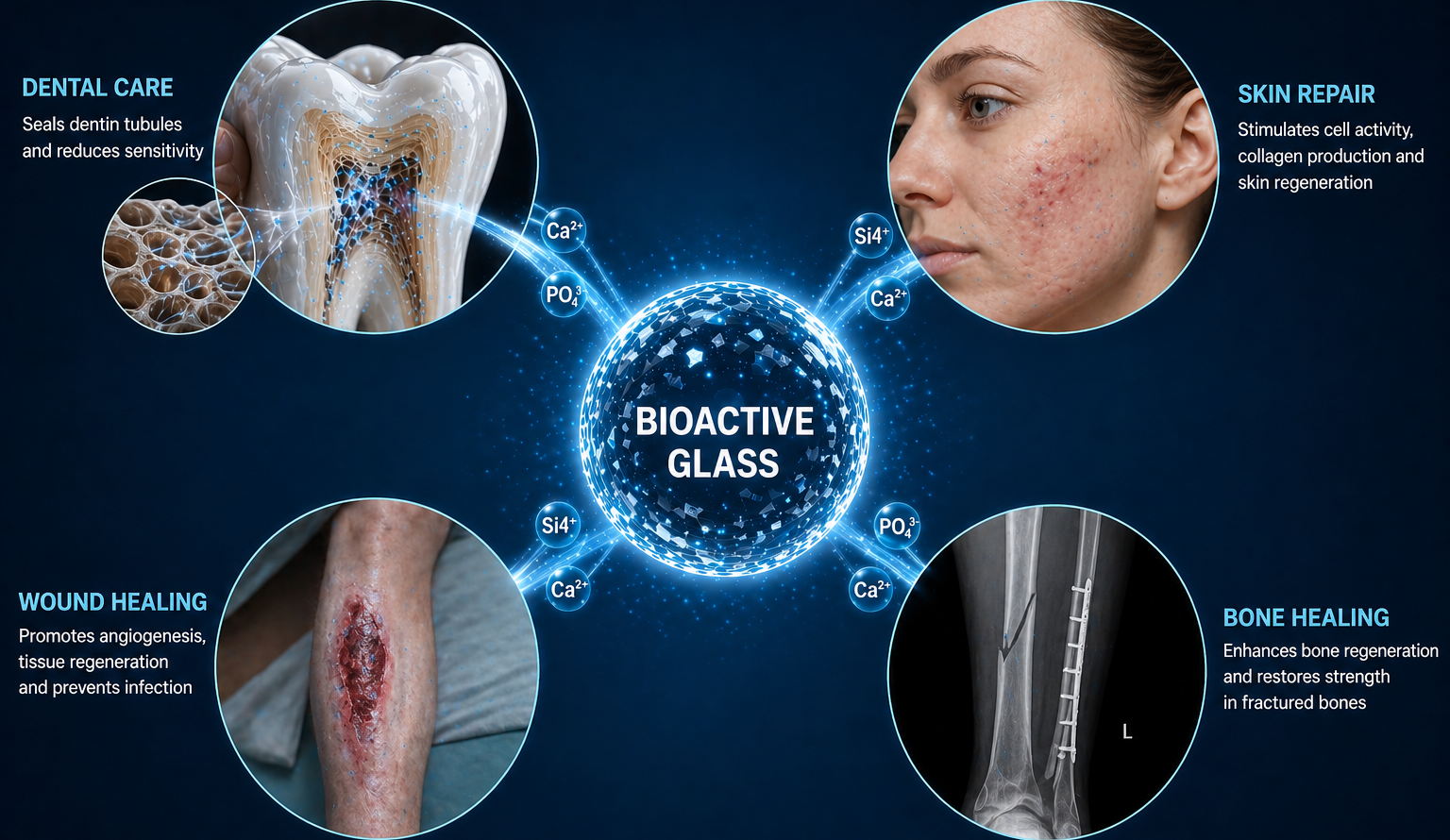
Bioactive glass has also been investigated for dental bone grafting and bone-regeneration applications.
Research and clinical literature have evaluated different bio-active glass compositions for dentistry and reconstructive surgery. [1,4]
Potential areas of investigation include:
This makes bio-active glass an area of interest not only in orthopaedic bio materials but also in dental and maxillofacial applications.
One reason inject-able bio-active glass is being investigated is the possibility of combining the bio-active properties of glass-based bio materials with the delivery and handling advantages of an inject-able formulation.
| Feature | Injectable Bioactive Glass | Conventional Graft Materials |
| Delivery | Potentially injectable | Often requires direct placement |
| Defect adaptation | Can potentially conform to irregular defects | Depends on graft geometry |
| Bioactivity | Bioactive glass surface reactions | Depends on material |
| Composition control | Can be engineered | Depends on material/source |
| Handling | Can be formulated as a paste | Often particulate, granule or solid |
However, it is important to understand that this comparison does not mean inject-able bio-active glass is automatically superior to conventional graft materials.
The scientific literature supports the investigation of bio-active glass in different physical forms, while the specific advantages of an inject-able formulation depend on the final formulation and clinical application. [2,4]
Developing an inject-able biomaterial involves balancing several requirements.
The material needs to be inject-able and manageable while also providing the required biological and physical characteristics.
Important development considerations include:
These factors highlight why developing an inject-able bone graft substitute is a formulation and bio materials challenge rather than simply a matter of making bio-active glass inject-able.
Injectable bio-active glass represents a promising research direction in minimally invasive bone repair.
Its combination of bio-active properties and the potential for inject-able delivery makes it an interesting platform for developing bio materials for orthopaedic and dental applications.
Research on 45S5 bio-active glass has demonstrated considerable interest in bone regeneration, while newer research is exploring advanced formulations, composites and regenerative strategies. [1,2]
At the same time, there are important challenges that need to be addressed before these materials can be translated into broader clinical applications.
Successful development requires careful optimization of:
Further preclinical and clinical research will therefore be important in understanding how inject-able bio-active glass formulations can be developed and translated into broader clinical applications. [2,4]
Injectable bio-active glass brings together two important concepts in bone regeneration: the bio-active properties of bio-active glass and the potential delivery advantages of an injectable formulation.
The research around 45S5 bio-active glass, bone defects, dental bone grafting and regenerative medicine demonstrates why this material continues to attract scientific interest.
Its ability to be investigated in different forms, combined with the possibility of delivering an injectable formulation into localized or irregular defects, makes it an interesting platform for minimally invasive bone repair.
However, inject-able bio-active glass is still an area of active research. Its success depends on carefully balancing formulation, biological and physical characteristics, followed by appropriate preclinical and clinical evaluation.
As research progresses, injectable formulations, composites, and other advanced approaches may continue to expand the possibilities being explored in bone regeneration and regenerative medicine.
Contact us through Synthera Biomedical social platforms to stay informed about pioneering bioactive glass research and clinical applications. Follow us on Instagram for product launches and research updates. Join the conversation on Facebook to access valuable resources and community news.
[1] Nogueira, D.M.B., et al. (2024). Update on the use of 45S5 bio-active glass in the treatment of bone defects in regenerative medicine. World Journal of Orthopedics, 15(3), 204–214.
[2] Zhu, Y., et al. (2025). Bioactive glass in tissue regeneration: Unveiling recent advances in regenerative strategies and applications. Advanced Materials, 37(2), e2312964.
[3] Jones, J.R. (2015). Bioactive glasses: Frontiers and challenges. Frontiers in Bioengineering and Biotechnology, 3, 125.
[4] Bioactive Glass Applications: A Literature Review of Human Clinical Trials. (2020). Journal of Functional Biomaterials, 11(1).